

In 2016, methane (CH4) accounted for about 10 percent of all U.S. greenhouse gas emissions from human activities. Human activities emitting methane include leaks from natural gas systems and the raising of livestock. Methane is also emitted by natural sources such as natural wetlands. In addition, natural processes in soil and chemical reactions in the atmosphere help remove CH4 from the atmosphere. Methane's lifetime in the atmosphere is much shorter than carbon dioxide (CO2), but CH4 is more efficient at trapping radiation than CO2. Pound for pound, the comparative warming impact of CH4 is more than 25 times greater than CO2 over a 100-year period.
1. Cattle and Methane
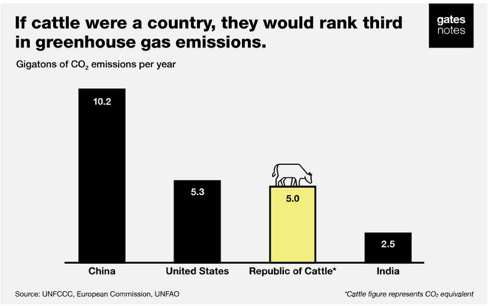
Cattle are a huge source of methane; in fact, if they were a country, they would be the third-largest emitter of greenhouse gases! Gates Notes Oct 17,2018
The atmospheric concentration of methane has risen dramatically in the modern age.
One method of decreasing the atmospheric methane concentration would be to decrease the production of methane by cows. This, in fact, has been achieved. Multiple reports have shown that adding a small amount of red seaweed to cows diet dramatically decreases their production of methane (1). The compounds responsible for this effect are bromoform (CHBr3), bromochloromethane (BCM) (CH2BrCl) and di-BCM (CHBr2Cl)(1). Since these compounds are illegal to make in some countries because of risk to ozone depletion, it will be safer to make red algae commercially for cattle. Research need to be done to determine the best methods for this. The Comings Foundation will provide grants to accomplish this. We propose to integrate this with the ocean farming of seaweed.
Another method of reducing the release of methane by cows is to oxidize the methane emissions from the nostrils of cows.
Zelp is a company in London that is promoting the use of a mask for cows that oxidizes the methane present in cattle exhalations. Up to 95% of methane emissions come from the mouth and nostrils of the animal. Zelp technology measures, captures and oxidizes methane in real-time, with the capacity to target vast quantities of methane.
The cattle wearable attaches to regular halters in a non-intrusive way and, as well as converting methane, it has the added capacity to improve animal welfare by capturing, analyzing and processing large amounts of data on each animal.
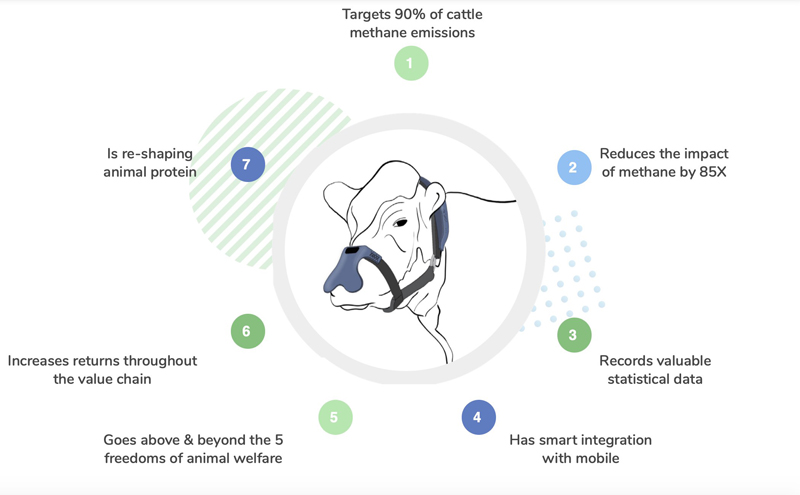
The novel aspect of this technology lies in the process we have developed for oxidizing the highly diluted methane exhaled by cattle. This process incorporates novel catalytic technology that has been successfully tested in laboratories with proven catalytic efficiency under conditions that replicate those on the cow. This technology has also been tested through numerous behavioral trials which evaluate the impact of the wearable on animal behavior as well as production yields, rumination, rest and activity periods and feed intake.
1. Kinley, R et al: The red macroalgae Asparagopsis taxiformis is a potent natural antimethanogenic that reduces methane production during in vitro fermentation with rumen fluid. Animal Production Science 56:282-289, 2016.
2. Tropical Forests and Methane
The tropical wetlands have been found to emit large amounts of methane into the atmosphere (2). Further research on this is needed but this source of methane would be hard to combat other than by removing it from the atmosphere.
2. Tollefson. J. Tropical African could be key to solving methane mystery. Nature 566:165-166, 2019.
3. Methane Levels are increasing.
The following figure shows how methane levels are increasing over recent years.
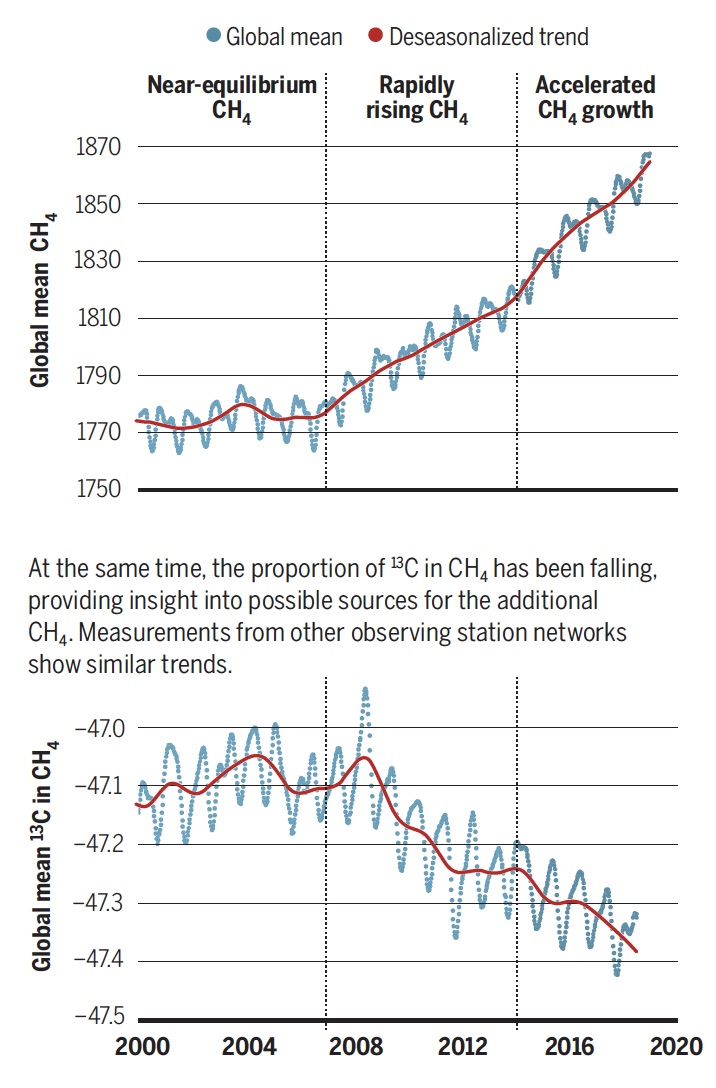
The reasons for this increase are those mentioned above - cattle and tropical forests, as well as coal mining in East Asia. An additional source may be the melting of permafrost in Siberia and other Arctic regions. This further emphasizes the need to both cut down on methane emissions and remove methane from the atmosphere.
3. Fletcher and Schaefer: Rising methane: A new climate challenge. Science 364:932-933, 2019.
4. The Removal of Methane from the Atmosphere with Solar Chimneys
Even if humans stop combusting fossil fuels and discharging CO2 into the atmosphere, the average global temperature of the earth will continue to increase for the rest of the century for several reasons.
Firstly, the long lifetime of CO2 (estimated in the 100,000 year range) means that the excess atmospheric stocks (515 GtCarbon) would continue to drive radiative forcing and global warming for many decades.
Secondly, even if atmospheric concentrations were to decrease, CO2 would out gas from the oceans and off set this decrease, because of the dynamic equilibrium between the CO2 in the atmosphere and the carbonates HCO3¡/CO32¡ dissolved in the oceans.
Thirdly, there is the contribution of other GHGs, besides CO2, which together account for about 34% of radiative forcing. Even if all excess anthropogenic atmospheric CO2 were removed, radiative forcing would only be reduced by half. The following is a proposal on how the remove the other half.
A hybrid of a Solar Chimney Power Plant (SCPP) and a Photo-Catylatic Reactor (PCR) has been proposed as a method of removing non-CO2 greenhouse gases. The concept is shown here.
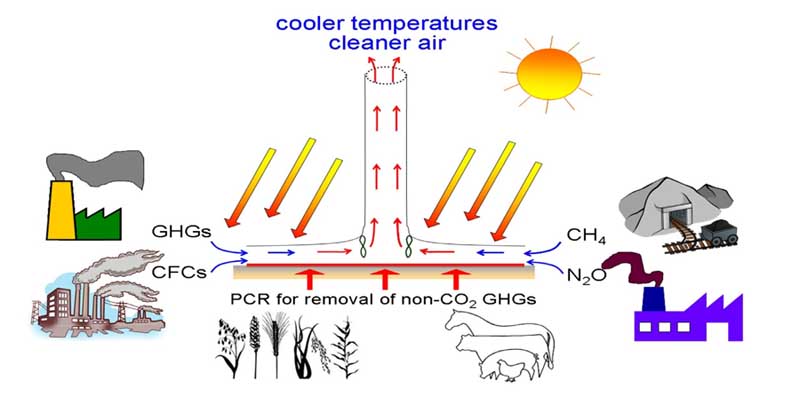
The SCPP is an established concept that generates electricity in a solar updraft tower incorporating axial-flow turbines. Hot air is supplied to the tower by a large solar hot air collector. A conventional SCPP-PCR is composed of 4 principal components:
1. A very large collector for the greenhouse effect;
2. A tall chimney for the stack effect;
3. A thermal energy storage layer (water) to store the solar radiation for night time operation;
4. Several turbines to generate renewable electricity which is carbon free.
PCR can be incorporated in the SCPP by coating its collector with a photo catalyst, such as TiO2, which is able to transform methane and other non-CO2 GHGs into less harmful products.
Transformation of 1 kg of methane into 2.75 kg of CO2 reduces its climate change effect by 90%, and is equivalent to removal of 25.25 kg of CO2 from the atmosphere.
The SCPP component produces sustainable decarbonized renewable energy. Photo catalysis avoids the need for capture and sequestration of these atmospheric components.
World wide installation of 50,000 SCPPs, each of capacity 200 MW, would generate a cumulative 34 PWh of renewable electricity by 2050. These SCPP-PCP devices would reduce or stop the atmospheric growth rate of the non-CO2 GHGs and progressively reduce their atmospheric concentrations.
The Comings Foundation could supply the funds to build a 200 MW prototype proof of concept.
deRichter, R. et al.:Removal of non-CO2 greenhouse gases by large-scale atmospheric solar photocatalysis. Progress in Energy and Combustion Science 60:68-96, 2017.
Schlaich,Jorg: The Solar Chimney. Edition Axel Menges, Stuttgart, 1995. ISNB 3-930698-69-2
Schlaich,J.et. at.: Design of commercial solar updraft tower systems-Utilization of solar induced convective flows for power generation. J Sol Engineering 127:117–24, 2005.
5. Development of non-greenhouse gas refrigerants
The book Drawdown compiled a list of 100 projects that would help combat global warming and assessed the relative impact of each. Number 1 on the list was the release of refrigerants into the atmosphere.
One kilogram of a typical refrigerant gas contributes as much to the greenhouse effect in our planet’s atmosphere as two tons of carbon dioxide, which is the equivalent of running a car uninterruptedly for six months. On method of combating this is the development on non-greenhouse gas refrigerants. Materials called plastic crystals have been found to undergo huge temperature changes when subjected to small pressures near room temperature. Such materials could form the basis of save future refrigeration technologies. (Nature 567:506-510, 2019). The ComingsFoundation.org will support the development of this new technology.
6. Support Methane Satellite Fred Krupp of the Environmental Defense Fund is obtaining TED Audacious Project funds for the launching of a methane detecting satellite. This will identify oil and gas companies around the world whose facilities are releasing methane, often unknown to them. Experience shows that they are informed of this release they often fix the problem. This approach may reduce the world wide release of methane by 50 percent. Go to YouTube, search for Methane Satellite Fred Krupp TED talk.
In addition, some of the critical data regarding tropical methane production comes from a monitoring station on the Ascension Island in the Atlantic. Funding for this station is threatened.